

Your manager pings you at 5 pm. 30 category pages need fresh meta descriptions by tomorrow. You’ve heard AI SEO is the future, so you paste the first page title into ChatGPT and type: “write a meta description for this page.” What comes back is polite, 150 characters long, and could describe any page on any website. You rewrite it by hand. Then the next 29.
The tool was fine. It just had nothing useful to work with. No target keyword, no idea who searches for the page, no brand voice, and no facts about what makes that category useful. Almost everyone starts here.
The meta description that could describe any page
A generic meta description usually comes from a generic request, not from a problem with the AI tool.
If your prompt only says “write a meta description for this page”, the AI knows the page title but very little else. It does not know what the searcher wants, which keyword matters, what makes your page different, or how your brand normally speaks.
That is why the first attempt often sounds fine and still feels useless. You spend another few minutes rewriting it, then repeat the process for every page.
If you are wondering what is AI SEO, this is a useful place to start. The term sounds bigger than the change most SEO professionals need to make in their daily work.
Current as of September 2026: Google’s current guidance on generative AI features was last updated on July 10, 2026. Google can change its Search guidance and AI features, so check the linked guidance before acting on version-specific advice.
What is AI SEO? The short answer
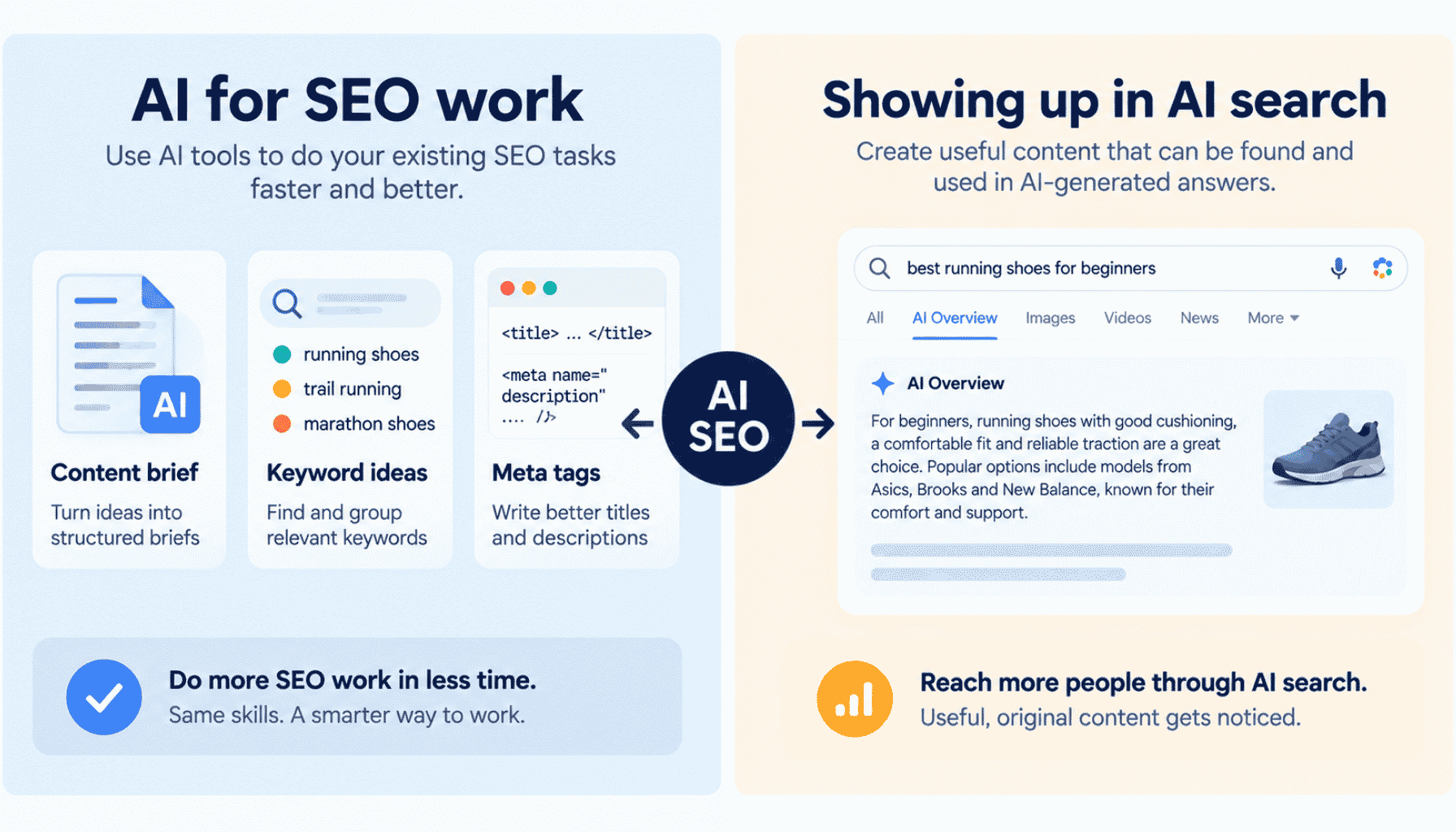
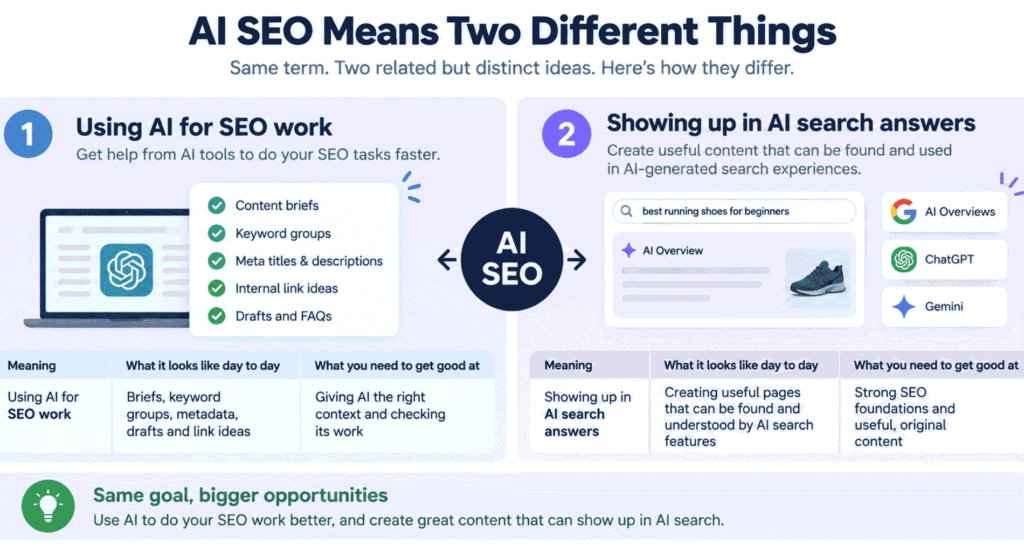
AI SEO is a loose label for 2 different things: using AI tools to do SEO tasks faster, and getting your content shown in AI-generated search answers such as Google’s AI Overviews and AI Mode.
Most of the confusion comes from people using the same phrase for both. They are related, but the work involved is different.
| Meaning | What it looks like day to day | What you need to get good at |
|---|---|---|
| Using AI for SEO work | Briefs, keyword groups, metadata, drafts and link ideas | Giving AI the right context and checking its work |
| Showing up in AI search answers | Creating useful pages that can be found and understood by AI search features | Strong SEO foundations and useful, original content |
Meaning 1: using AI to do your SEO work
Using AI for SEO means giving part of your existing SEO work to an AI tool while you remain responsible for the brief, facts and final decision.
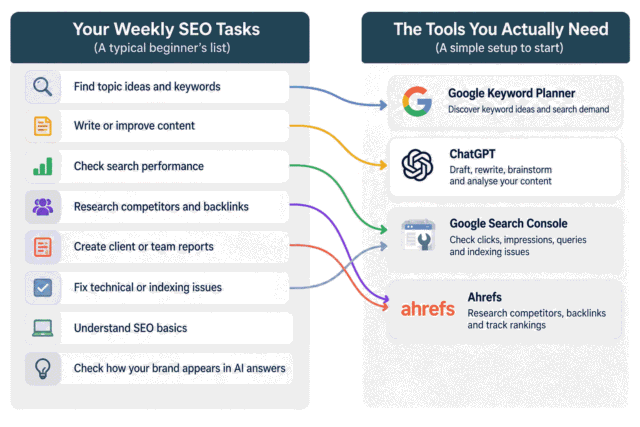
For example, an SEO executive can use Claude, ChatGPT or Gemini to help with tasks such as:
- Turning a rough topic into a content brief.
- Grouping related keywords by search intent.
- Writing meta titles and meta descriptions.
- Suggesting possible internal links between relevant pages.
- Creating a first draft of an FAQ section.
The important part is the handoff. You give the AI enough information to do the particular job, then check what it produces against the real page.
Google’s guidance says generative AI can be useful for research and adding structure to original content. It also says generating many pages without adding value for users may violate Google’s spam policy on scaled content abuse. Google’s guidance on using generative AI content also asks site owners to focus on accuracy, quality and relevance, including for metadata such as title elements and meta descriptions.
You can think of this meaning as AI for SEO. Your SEO fundamentals do not disappear. You are changing how you complete some of the work.
Meaning 2: showing up in AI search answers
The second meaning of AI SEO is improving the chances that your content is used or surfaced in AI-generated search experiences.
Google’s AI Overviews and AI Mode are examples of this. ChatGPT and Gemini can also answer questions directly and may use information from websites when producing answers.
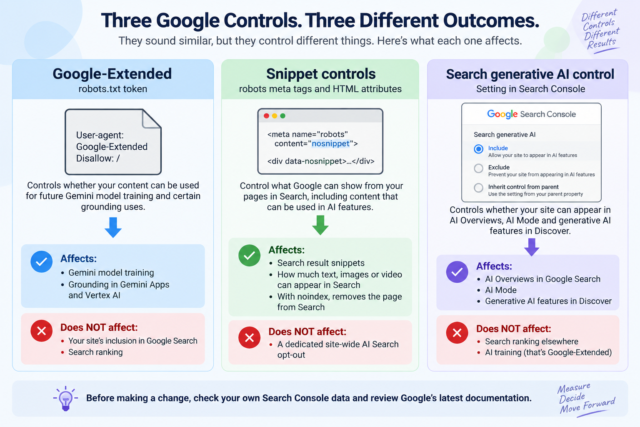
For Google Search specifically, Google’s current guide says its generative AI features are rooted in its core Search ranking and quality systems. It also says that, from Google’s perspective, optimising for generative AI search is still SEO. You may see this work described using labels such as AEO, or answer engine optimisation, and GEO, or generative engine optimisation. Google’s guide to optimising for generative AI features explains the current position in more detail.
That guide also says you do not need to create special files such as LLMS.txt for Google Search, and there is no requirement to break your content into tiny pieces just for AI systems. Those points apply to Google Search. They should not be treated as a statement about how every other AI assistant handles websites.
If you want to see the practical side of this, read how to rank in AI Overviews and then check whether AI search is already sending traffic to your site.
Why AI SEO feels overhyped the first time you try it
AI SEO often feels disappointing at first because the user gives the AI too little information to produce useful SEO work.
You already know what a good meta description should do. You know the target keyword. You have some idea of the person searching and what makes the page worth visiting. The AI does not know any of that unless you tell it.
So the problem is often not the AI. It is how the task has been described.
A one-line request leaves the tool guessing. A useful prompt gives it the same basic information you would give a junior colleague before asking them to complete the task.
One AI SEO habit that saves real time: better meta description prompts
The fastest way to get a usable meta description from AI is to give it the keyword, searcher, page facts, brand voice and limits before asking it to write.
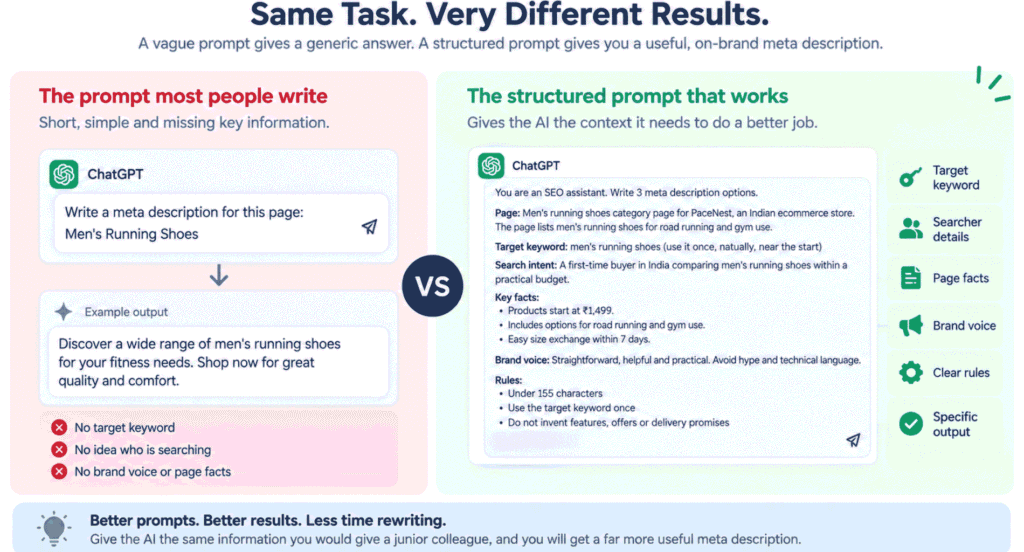
The prompt most people write
The usual prompt is short because the task looks simple:
Write a meta description for this page: Men's Running ShoesThere is nothing wrong with starting simply. The problem is that the AI has almost no information to work with. It does not know who is searching, what the category contains, which keyword you are targeting, what makes the page useful or how the brand normally sounds.
The result can therefore be grammatically correct and still generic.
The version that works
A more useful prompt gives the AI the information that a human SEO writer would need before writing the same description.
You are helping an SEO executive write meta descriptions for an online store.
Page: Men's running shoes category page for PaceNest, a fictional Indian ecommerce store. The page lists men's running shoes for road running and gym use.
Target keyword: men's running shoes
Use the target keyword once, naturally, near the start.
Who searches for this page:
A first-time buyer in India who is comparing men's running shoes and wants to stay within a practical budget in rupees.
Facts about this page:
- Products start at ₹1,499.
- The category includes options for road running and gym use.
- Customers can request a size exchange within 7 days.
Use only the facts given above. Do not invent product features, discounts, delivery promises, materials, brands or performance claims.
Brand voice:
Straightforward, helpful and practical. Avoid hype and technical language.
Example of a meta description the brand already likes:
"Simple choices for everyday runners, with clear prices and useful details."
Rules:
- Keep each option under 155 characters.
- Use the target keyword once.
- Do not use ALL CAPS.
- Do not use exclamation marks.
- Do not make claims that are not included in the facts above.
- Give the searcher a clear reason to visit the page.
Output:
Give me 3 options.
For each option, show the meta description first and then its character count.
Check each option against the live page before publishing, because AI can still add a detail that is not true.
The difference is simple. The first prompt gives the AI a page name and asks it to fill in the rest. The second gives it the keyword, searcher, page facts, brand voice and writing limits. Those details narrow the task in the same way a proper brief helps a human writer.
Check it before it goes live
Every AI-written meta description should be checked against the actual page for accuracy, relevance and the required length.
Google’s guidance specifically includes metadata such as meta descriptions when it tells site owners to focus on accuracy, quality and relevance. Google’s guidance on generative AI content is the reference to check when you are using AI to assist with this work.
For a wider approach to using AI for SEO writing, you can also read the Claude SEO Writing Playbook.
What AI SEO does not change
AI SEO does not remove the basic work of making pages crawlable, indexable, useful and easy to understand.
Google’s current generative AI guide says its AI Search features are rooted in core Search ranking and quality systems. It also says pages need to meet Google’s Search requirements to be eligible for generative AI features, and that following the requirements does not guarantee that a page will be crawled, indexed or served.
That is why any claim that AI SEO lets you skip the basics deserves a careful look. Google’s own guidance continues to point site owners towards clear technical structure, useful content and established SEO practices.
Google also warns that third-party tools do not have access to its internal ranking or AI systems. A tool can still be useful for your workflow, but its advice should be checked against Google’s published guidance.
Frequently Asked Questions
what is ai seo called
AI SEO is also described using terms such as AEO, or answer engine optimisation, and GEO, or generative engine optimisation, when the focus is visibility in AI search experiences. Google says that, from its perspective, optimising for generative AI search is still SEO.
does ai seo really work
AI SEO can help when it means using AI to assist with useful SEO work or applying sound SEO practices to pages that may appear in AI search features. Google’s guidance does not give a success rate for AI SEO, and its systems do not guarantee that a page will appear in a generative AI result.
will ai replace seo
My view is that AI is changing how some SEO tasks are done rather than removing the need for SEO itself. Google’s current guidance says its generative AI features are rooted in core Search ranking and quality systems, so understanding search intent, useful content and technical SEO remains relevant.
how can i learn ai seo
Start with the first meaning of AI SEO by using AI on SEO tasks you already understand, such as keyword grouping, metadata or content briefs. Then build from there instead of treating AI SEO as a completely separate subject.
Try this before your next batch of meta descriptions
Pick 5 pages that need new meta descriptions and use the structured prompt on each one.
For each page, replace the keyword, searcher and facts with the real information from that page. Then compare the AI options with the description you would have written yourself and keep only versions that are accurate and useful.
Once that prompt works for your process, turn it into something reusable with Claude Skills.
Leave a Reply