

Day 1. You are handed a keyword, a word count and a Thursday deadline. No brief. No outline. No example of what good looks like. You open ChatGPT and type, “write a 1500 word SEO article about [keyword].” The result sounds fine until you realise it sounds exactly like the 40 articles already ranking for it.
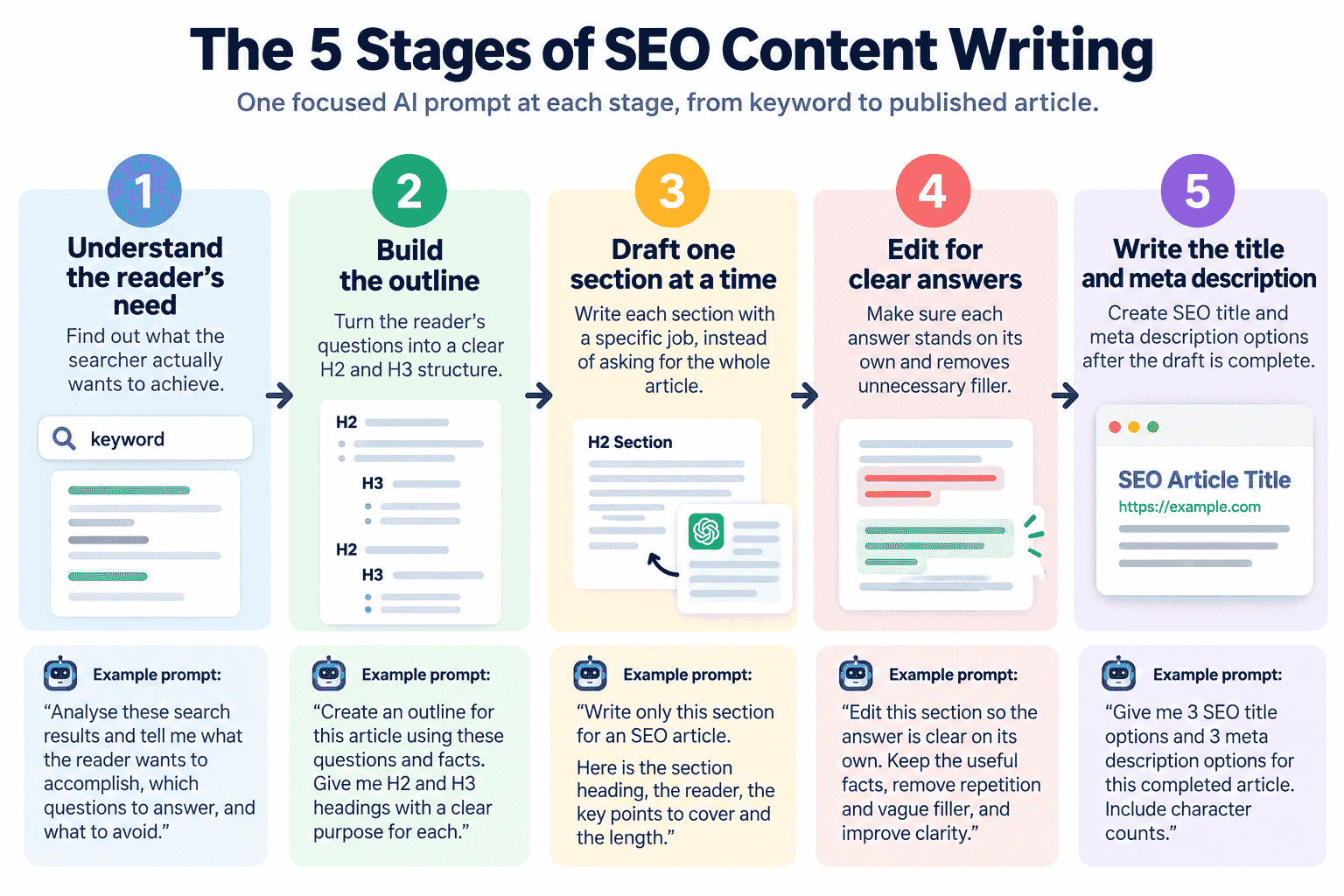
That is the problem. SEO content writing is 5 smaller jobs, not 1 big one. Give AI 1 prompt for each stage, and none of them needs to be “write the article”.
What SEO content writing actually is
SEO content writing means creating useful content for a real reader while structuring it so search engines can understand what the page covers. The goal is to help the reader first, then make the page clear and discoverable through search.
Google’s current guidance says its ranking systems are designed to prioritise helpful, reliable information created to benefit people rather than content made mainly to manipulate rankings. It also says SEO can be useful when it is applied to people-first content. Google’s guidance on creating helpful, reliable, people-first content explains the questions creators can use to assess their own work.
That changes how you should approach an SEO article. You are not starting with a keyword and asking AI to fill 1,500 words around it. You are starting with the reader’s need, deciding what the page needs to answer, and then building the article around those answers.
For a junior SEO, this is useful because the same sequence can be repeated for your next article, even when the topic changes.
The 5 stages of SEO content writing, and the prompt for each
Good SEO content writing works better when you separate intent, structure, drafting, editing and search-result copy into 5 distinct stages.
1. Work out what the reader actually wants
The first stage is to identify the reader’s actual goal before you write a single paragraph.
A keyword tells you what someone typed. It does not automatically tell you what they expect to find after clicking a result.
For example, someone searching “how to write SEO content” probably needs a process they can follow. Someone searching “SEO content writing course” has a different need. Treating both queries as the same writing task is an easy way to start with the wrong article.
Give AI the search results or the information you have collected, rather than asking it to guess what the reader wants.
You are helping me plan an SEO article.
Primary keyword: [keyword]
Here are the search results, questions, or notes I collected:
[paste them here]
Tell me:
1. What is the main thing the searcher wants to accomplish?
2. What questions does the page need to answer?
3. What would make a result fail to satisfy this search?
4. What should this article avoid covering because it is outside the reader's main need?
Do not write the article. Give me the intent and the content requirements only.
A bad output is one that simply repeats the keyword and says the intent is “informational” without explaining what the reader actually needs.
2. Build the outline from real questions
The second stage is to turn the reader’s needs into headings that answer those needs in a sensible order.
This is one of the steps people skip most often. They ask AI for an outline and accept a familiar structure such as introduction, benefits, tips, conclusion. It may look neat, but it does not prove that the article will answer the questions that brought the reader there.
Use the questions and information you collected in stage 1.
Create an outline for one SEO article.
Topic: [topic]
Primary keyword: [keyword]
Reader: [who the reader is]
Main reader need: [what they want to accomplish]
Questions the article must answer:
[paste the real questions here]
Facts or points the article must cover:
[paste the facts here]
Create a practical outline using H2 and H3 headings.
Rules:
- Every heading must have a clear purpose.
- Put the most important answer early.
- Do not add sections just to increase word count.
- Do not invent questions, facts, statistics, examples or sources.
- Do not write the article yet.
A weak outline has headings that could belong to almost any article on the subject. A useful outline makes it obvious what question each section will answer.
Most people skip this stage and the next one. Those are the 2 stages that separate an outline that looks complete from an article that is actually useful.
3. Draft one section at a time
The drafting stage is where you should stop asking AI for the whole article and ask it to write one specific section.
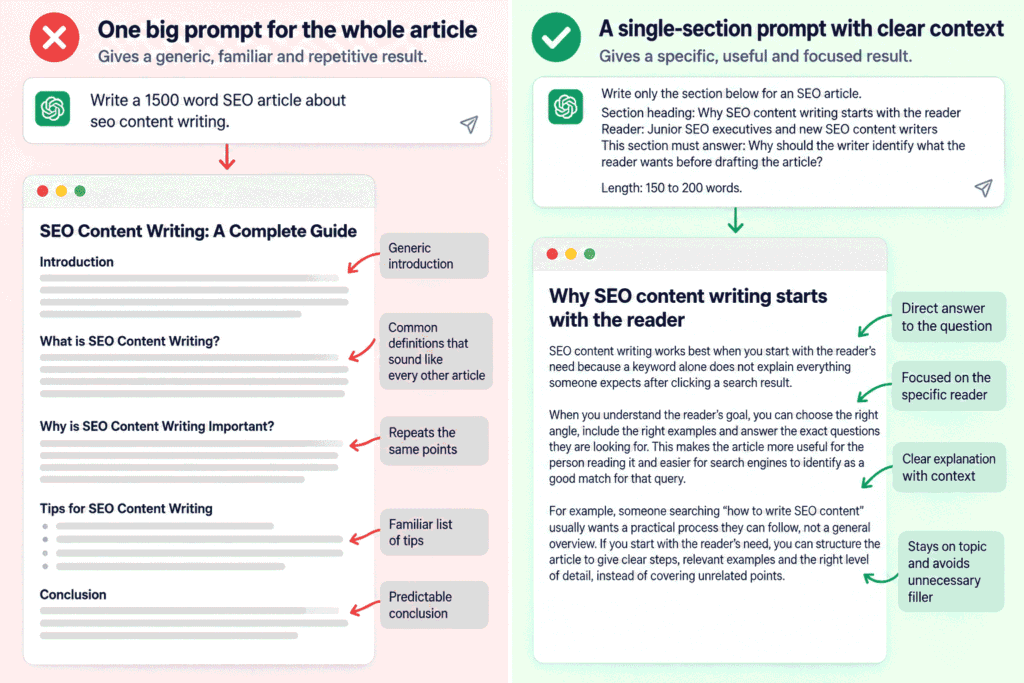
Here is the prompt most beginners naturally write:
Write a 1500 word SEO article about [keyword].That prompt gives the model a large empty space to fill. Once it starts filling that space, generic introductions, repeated points and familiar conclusions can creep in.
Instead, give it one heading and a clearly defined job.
Write only the section below for an SEO article.
Section heading: Why SEO content writing starts with the reader
Reader: Junior SEO executives and new SEO content writers who can write well but are learning how to structure content for search.
This section must answer:
Why should the writer identify what the reader wants before drafting the article?
Use only these facts and examples:
- SEO content should be useful to a real reader.
- The article should answer the reader's main need.
- A keyword alone does not explain everything the reader expects.
- Example keyword: "how to write SEO content".
- Example reader need: a practical process for creating the content.
Do not add facts, statistics, examples or sources beyond the points above.
Length: 150 to 200 words.
Rules:
- Start directly with the answer.
- Do not open with a summary of the article.
- Do not end with a summary sentence.
- Do not mention this prompt or these instructions.
- Write in plain English.
The difference is simple. The first prompt asks for 1,500 words and leaves the model to decide what belongs in them. The second gives it one job, one reader, one question, specific material to use and a clear limit. There is much less room for filler.
4. Edit so each answer stands on its own
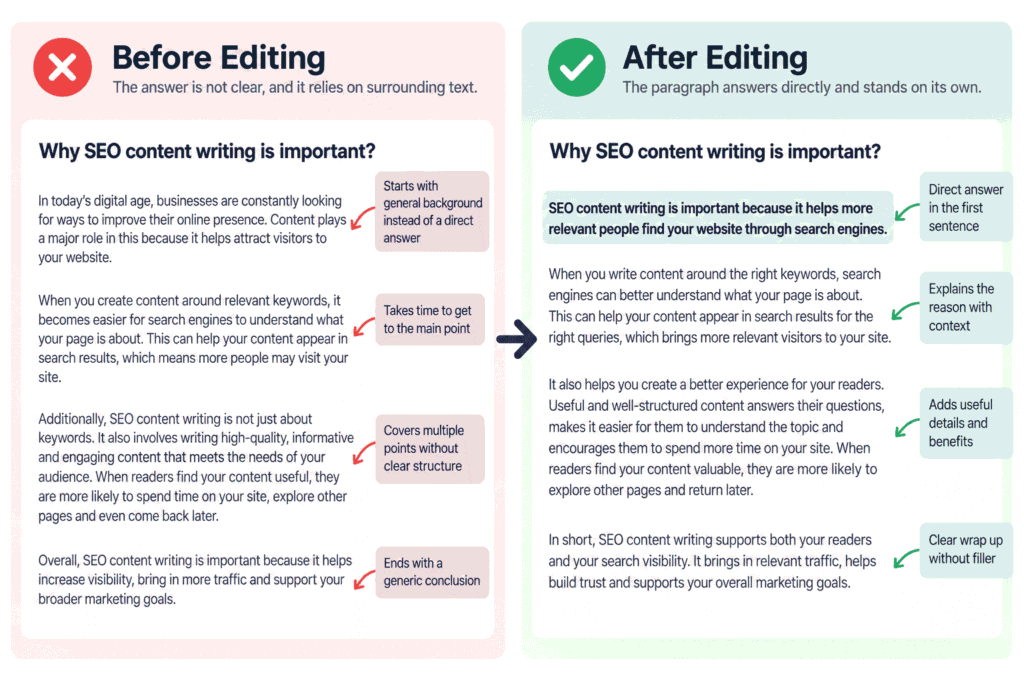
The fourth stage is to edit each important passage so a reader can understand the answer without needing the paragraph before it.
This does not mean chopping every section into tiny pieces. It means checking whether the first sentence actually answers the question and whether the passage contains enough information to make sense on its own.
For example, if a section is answering “What is SEO content writing?”, do not make the reader wait through 3 paragraphs before reaching the definition. Put the answer first, then explain it.
That approach is also useful as search changes. Google’s current guidance for generative AI features says SEO best practices remain relevant, and it recommends content that is useful, well organised and easy for people to follow. It also says there is no special writing style required just for generative AI search. Google’s guide to optimising for generative AI features on Search covers this in more detail.
You can also read how to write content for AI Overviews if you want to go deeper into this part of the workflow.
Edit the section below so the answer is clear even if someone reads this section by itself.
Section question: [question]
Draft:
[paste the section here]
Rules:
- Start with a direct answer to the section question.
- Keep the useful facts and examples.
- Remove repetition and vague filler.
- Do not add facts, statistics, examples or sources that are not already in the draft.
- Make unclear references specific.
- Keep the section's original meaning.
- Do not add an introduction or conclusion to the section.
- Use plain English.
A bad edit changes the meaning, adds unsupported information or turns every paragraph into the same short pattern. The goal is clearer answers, not shorter writing for its own sake.
5. Write the title and meta description last
The title and meta description should be written after you know what the article actually says.
Writing them first can push you into making promises that the finished article does not fully deliver. Once the draft is complete, you have the actual angle, answers and useful details in front of you.
Write 3 SEO title options and 3 meta description options for the completed article below.
Primary keyword: [keyword]
Reader: [who the article is for]
Article:
[paste the completed article here]
Rules:
- Each title must accurately describe the article.
- Each title should use the primary keyword naturally where it fits.
- Each meta description must accurately describe what the reader will get.
- Do not make claims that the article does not support.
- Do not use clickbait.
- Keep each meta description under 155 characters.
- Give me the character count for each option.
A weak option promises a benefit that the article never provides. A useful option tells the searcher what the page contains and gives them a reason to choose it without exaggerating.
What AI should not do in this process
AI should not be the final authority on facts, statistics, sources or whether a claim is true.
It can help you organise information and produce a draft, but you still need to check factual claims before publishing. Never publish a number or source simply because AI supplied it.
The same rule applies to the reader’s real questions. AI does not automatically know what your audience is asking in your particular situation. You need to provide the questions, research, customer language, product information or other material you are actually working from.
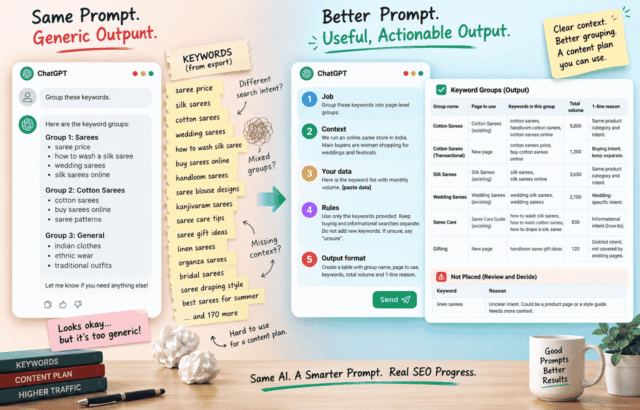
If you want to improve how you construct individual prompts, read How to Use ChatGPT for SEO Without Getting Generic Output. That is a deeper look at prompting itself. This post is about where the prompts belong in the writing process.
Does writing this way help with AI search?
Yes, the same people-first SEO process can support content that is useful in Google’s generative AI search features.
Google says its generative AI search features are rooted in its core Search ranking and quality systems, so existing SEO best practices remain relevant. Its current guidance also recommends useful, well-organised content that is written for people. :chatgpt-content-reference{index=”3″}
That is why stage 4 matters. If a section answers one clear question directly and contains enough context to make sense on its own, the reader has a better experience whether they arrive through a normal search result or an AI-assisted search experience.
There is no need to rewrite every sentence into a special “AI search style”. Google’s current guidance explicitly says you do not need to write in a specific way just for generative AI search. LLM SEO, and what actually changes in your day-to-day workflow goes further into the practical workflow changes.
Take your next SEO article through stage 1
Take the keyword sitting on your desk today and do only the first stage before you start writing: identify what the reader actually wants, what questions the page needs to answer, and what would make the result fail to satisfy them.
Once that is clear, move to the outline instead of asking AI to write the article. If you want a more structured writing system to keep beside you while you work, the Claude SEO Writing Playbook is a natural next read.
Frequently Asked Questions
What is SEO in content writing?
SEO in content writing means creating useful content for readers while making the topic and structure clear enough for search engines to understand. The writing should serve the reader’s need first.
How to write content in SEO?
Write SEO content by first identifying the reader’s need, then building an outline, drafting each section, editing the answers and writing the title and meta description. Use AI at each stage for a specific task instead of asking it to produce the whole article at once.
How to become a SEO content writer?
To become an SEO content writer, learn how search intent, content structure, on-page optimisation and useful writing work together, then practise by creating complete portfolio pieces. A good portfolio piece should show the keyword, the intended reader, the article structure and the finished content, so someone reviewing it can see how you approached the writing task.
Google’s SEO Starter Guide is a useful free foundation for understanding how SEO helps search engines understand content and helps users find websites.
How can I learn SEO content writing?
You can learn SEO content writing by combining Google’s SEO fundamentals with repeated practice on real topics and by studying how searchers’ questions become useful sections of an article. If you want a structured learning path after the basics, this guide on what to learn first in an AI SEO course is a useful next step.


Leave a Reply