
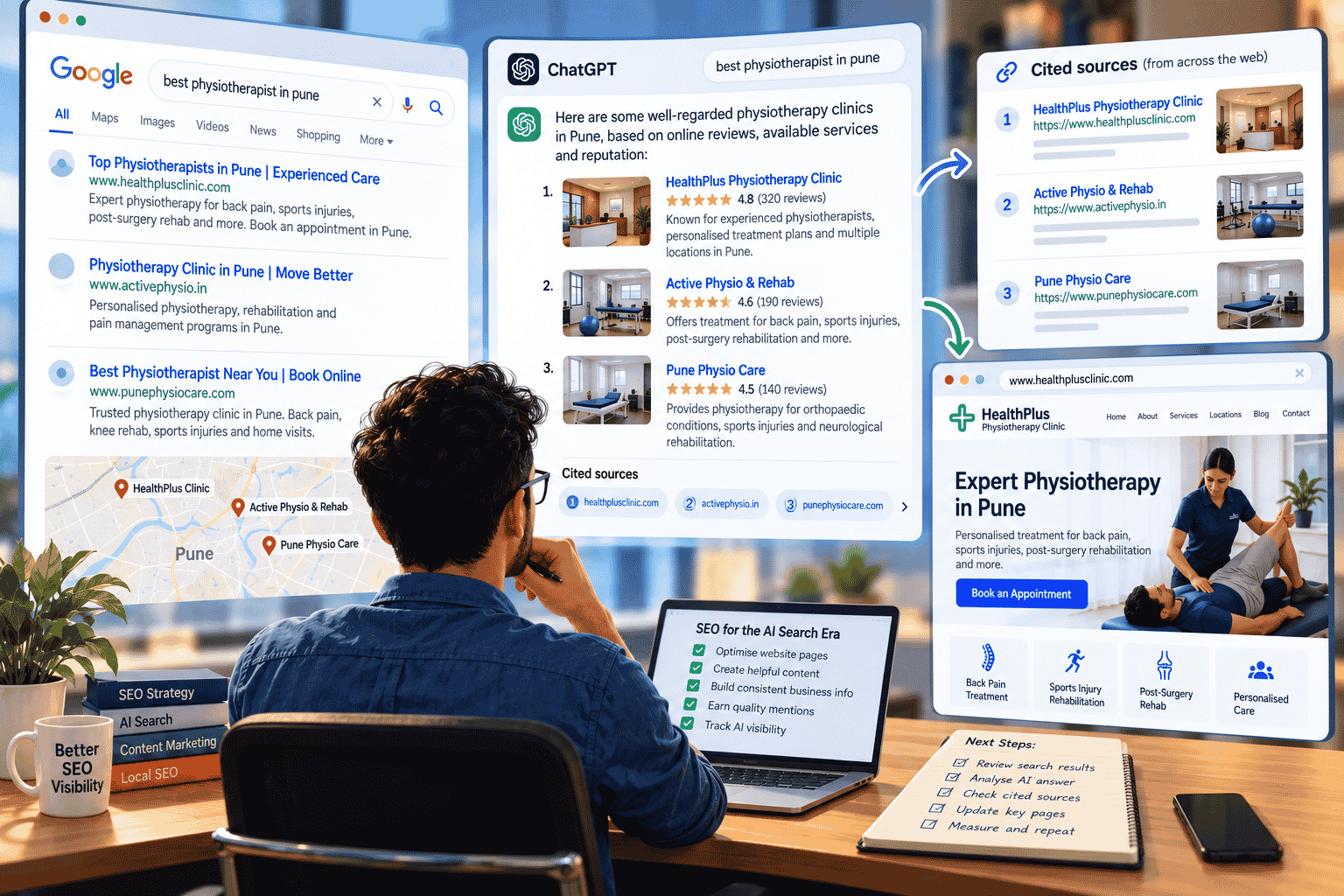

It’s 6:15 pm. Your manager has 2 asks before tomorrow’s review. First, why does ChatGPT name 3 competitor clinics when someone asks for a physiotherapist in Pune, but not yours? Second, the 12 branch pages on the site all have the same title and meta description, can you fix that tonight?
You open ChatGPT, paste the 12 URLs, and type: “Revise the titles and meta descriptions to maximize SEO performance. Put it in a table.”
A neat table comes back in seconds. 12 titles that all read “Best Physiotherapy Clinic in [Area] | Top Physio Near You”. 12 descriptions that differ by 1 word. You fix them by hand anyway. The ChatGPT question you don’t even attempt.
The problem is not that AI cannot help with SEO. The problem is that you gave it almost nothing to work with.
Why AI gives SEO professionals generic output
AI gives generic SEO output when the request contains the task but not the information needed to do the task properly.
That distinction matters. “Write a title” tells the AI what to produce. It does not tell it what the page actually offers, who the page is for, which search term matters, how the business speaks, or what makes one location different from another.
So the system fills those gaps using familiar patterns. That is why 12 branch pages can end up with 12 versions of the same title.
The same problem appears in larger SEO tasks. You ask for a service page and get a page that could belong to any company. You ask for an FAQ and get questions every competitor already has. You ask for an SEO strategy and receive a list of familiar recommendations with no connection to your site.
There is another problem now. Your pages are no longer being discovered only through the traditional search result page.
SEO still matters in Google’s AI search
Google says its generative AI search features are built on its core Search ranking and quality systems, so its established SEO best practices still apply. :chatgpt-content-reference{index=”1″}
Google also describes a process called query fan-out. An AI system can take a user’s original question and run several related searches to gather information before producing an answer. For example, a question about removing weeds from a lawn can lead to related searches about chemical treatments, non-chemical methods, and preventing weeds from returning. :chatgpt-content-reference{index=”2″}
That changes how you should think about visibility.
For traditional search, the familiar goal is to earn a ranking and persuade the searcher to click. In an AI-generated answer, another possibility matters: your page can become one of the sources used to construct the answer.
Google itself says that optimizing for its generative AI search features is still SEO. The labels “AEO” and “GEO” may be useful when describing particular approaches, but Google does not present them as a separate replacement for SEO. :chatgpt-content-reference{index=”3″}
If you want a plain-English explanation of this change, you can also read this guide to AI SEO and the explanation of Generative Engine Optimization without the jargon.
AI search can change what a click means
AI-generated summaries can reduce the number of users who click traditional search results, at least in the Google data studied by Pew Research Center.
Pew analysed browsing data from 900 US adults during March 2025. Among Google searches where an AI-generated summary appeared, users clicked a traditional search result in 8% of visits. For searches without an AI summary, the figure was 15%. Users clicked links inside the AI summary itself in only 1% of visits. :chatgpt-content-reference{index=”4″}
Those figures describe US browsing behaviour from March 2025. They do not tell us what will happen to every website, every country, or every search query.
They do show why the old idea of SEO as “rank, get the click, and stop there” is becoming incomplete.
Your business needs to be understandable enough that a search system can connect it with the right questions. Your pages need enough useful information for those systems to use them as sources. And your business information needs to be consistent enough that an AI assistant can describe you accurately.
How to judge SEO advice before you act on it
The safest way to handle SEO advice is to sort it into 4 levels: confirmed, partly confirmed, unproven, and risky or contradicted.
| Level | What it means | What you should do |
|---|---|---|
| Confirmed | The search engine has stated it, or reliable research has directly measured it. | Use it, while checking the conditions. |
| Partly confirmed | The basic idea is supported, but only under specific conditions. | Use the supported part and respect the limits. |
| Unproven | The claim comes from an observation, correlation, or practitioner experience. | Treat it as a test, not a rule. |
| Risky or contradicted | The advice conflicts with published search policies or has no credible support. | Do not build your SEO process around it. |
This filter is useful because SEO advice often travels faster than the evidence behind it.
You will hear claims such as “never use sitemaps”, “brand mentions are the new backlinks”, “AI content is banned”, “create a page for every question”, or “buy an exact-match domain and point it at your main site.”
Those statements do not all deserve the same response.
Google says a sitemap can help discovery, particularly for a new site with few external links, although a sitemap does not guarantee crawling or indexing. :chatgpt-content-reference{index=”5″}
Google also says that scaled content abuse includes using generative AI to create many pages without adding value for users when the purpose is to manipulate Search rankings. That is different from saying that every piece of AI-assisted content is prohibited. :chatgpt-content-reference{index=”6″}
That distinction is easy to lose when SEO advice is reduced to a headline.
Start with the technical basics before asking AI to fix them
AI can help you sort a technical SEO problem, but it should work from actual site data rather than guesswork.
Start with a crawl export or the relevant data from your search tools. Give the AI the URL, status information, title, description, canonical information where available, and any other fields you have actually collected.
Then ask it to separate the findings into 2 groups: problems you can investigate yourself and issues that need developer attention.
For example, a useful instruction could be:
You are helping an SEO executive review a website crawl.
I will give you crawl data containing URL, status code, title, meta description, canonical URL, and redirect information.
Your job is to:
1. Identify obvious duplicate or conflicting URL versions.
2. Identify broken or incorrect redirects.
3. Identify pages with missing titles.
4. Identify pages where titles are duplicated.
5. Separate issues that an SEO executive can investigate from issues that should be checked by a developer.
6. Do not invent information that is not present in the data.
7. Explain each issue in plain English and state what evidence from the data led you to flag it.
Return the result in this format:
Issue
Affected URLs
Evidence
Suggested next check
SEO or developer
The important part is not the wording alone. It is the evidence you provide.
Google recommends reducing duplicate content and provides guidance around consolidating duplicate URLs. It also recommends simple, descriptive URL structures, with words separated by hyphens. :chatgpt-content-reference{index=”7″}
Do not turn that into a bigger claim such as “the URL slug is the most important ranking factor.” The supplied evidence does not support that statement.
Titles should describe the page, not repeat a template
Google recommends descriptive and concise title elements, avoiding keyword stuffing and repeated boilerplate titles. It also suggests concise branding, such as placing the site name at the beginning or end where appropriate. :chatgpt-content-reference{index=”8″}
This is exactly where the clinic example went wrong.
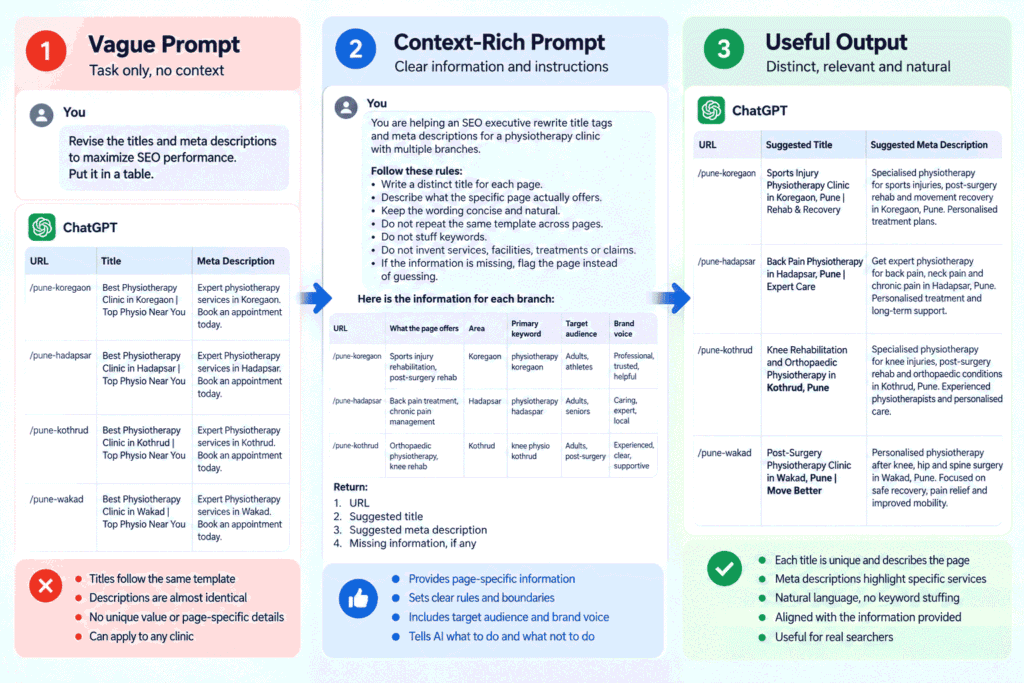
The original prompt asked AI to maximise SEO performance. It gave the system 12 URLs, but did not explain what each page actually offered.
That is not enough information to create useful titles.
Here is the vague version:
Revise the titles and meta descriptions to maximize SEO performance. Put it in a table.And here is a better version:
You are helping an SEO executive rewrite title tags and meta descriptions for a physiotherapy clinic with multiple branches.
Follow these rules:
- Write a distinct title for each page.
- Describe what the specific page actually offers.
- Keep the wording concise and natural.
- Do not repeat the same template across pages.
- Do not stuff keywords.
- Use the site name at the start or end only where it fits naturally.
- Do not invent services, facilities, treatments, doctors, claims, awards, or locations.
- If the information supplied for a page is too thin to write a genuinely distinct title or description, flag that page instead of guessing.
Use this information for each branch:
URL:
What the branch actually offers:
Area:
Primary search term:
Target audience:
Brand voice in 3 words:
Return:
1. URL
2. Suggested title
3. Suggested meta description
4. Missing information, if any
The second prompt gives the AI something the first one does not: facts.
It also gives the system a boundary. If the information is missing, it must flag the page instead of filling the gap with a generic marketing sentence.
Google’s current guidance also makes an important point about snippets. Google primarily creates snippets from the content on the page, but it may use the meta description when that provides a better description of the page. Google recommends unique, relevant descriptions for individual pages rather than repeating the same description across a site. :chatgpt-content-reference{index=”9″}
So don’t treat the meta description as a place to dump keywords. Write it as a short, accurate reason for the searcher to consider the page.
If you want another worked example, see how to use ChatGPT for SEO without getting generic output.
AI can draft content, but your business knowledge still matters
AI-assisted content works best when the person using it gives the system verified information about the business and checks the result before publishing.
Google says appropriate use of AI or automation is not against its guidelines. The problem is using automation to produce content at scale mainly to manipulate search rankings. :chatgpt-content-reference{index=”10″}
That makes your business information one of the most useful inputs you can give an AI system.
Create a simple brand fact sheet once. Include only facts you have verified.
- What the business does.
- Products or services actually offered.
- Areas genuinely served.
- Years in operation, if verified.
- Customer problems the business solves.
- Things customers commonly praise.
- Claims the business must not make.
Then use that fact sheet whenever you ask AI to draft or review a page.
For example:
You are writing SEO content using the verified brand facts below.
BRAND FACTS
[Paste verified fact sheet]
TASK
Create a page brief for:
Primary search term: [term]
Search intent: [informational or commercial]
Audience: [audience]
Required sections:
[sections]
Rules:
- Use only facts from the brand fact sheet.
- Do not invent statistics, credentials, results, customer stories, locations, services, or claims.
- Mark any statement that cannot be supported by the fact sheet.
- Avoid generic introductions and filler.
- Make the page useful to the person searching for this topic.
Return:
1. Search intent
2. Page angle
3. Recommended structure
4. Key facts to include
5. Claims that need verification
6. Draft brief
This is a much safer workflow than telling an AI to “write a service page for physiotherapy in Pune” and hoping it understands the business.
Do not create a page for every way someone can ask a question
A question deserves its own page only when it needs a full answer that does not belong naturally on an existing page.
AI makes it very easy to generate hundreds of pages from variations of the same query. That convenience can create a problem if the pages add little value.
Google’s scaled content abuse policy specifically covers creating many pages primarily to manipulate search rankings rather than help users. It also covers generating many pages with generative AI when those pages provide little value. :chatgpt-content-reference{index=”11″}
A better approach is to look at the questions your existing pages already attract.
Suppose a physiotherapy service page receives impressions for these queries:
- physiotherapy for back pain
- how long does physiotherapy take
- physiotherapy exercises after knee surgery
- best physiotherapy clinic near me
- physiotherapy vs chiropractor
Do not automatically create 5 new pages.
First check whether the current service page genuinely answers any of those questions. If it does, improve the relevant section. If a question needs a detailed explanation for a different audience or intent, then consider a separate page.
AI can help sort the data, but you make the final decision.
Local SEO needs accurate business information
Google says local results are mainly based on relevance, distance, and prominence.
Google also says review count and review score can factor into local ranking, while prominence can draw on things such as links, articles, and directories. It recommends keeping Business Profile information complete and accurate and responding to reviews. :chatgpt-content-reference{index=”12″}
This matters for businesses with multiple branches, including clinics, coaching institutes, service companies, restaurants, and retail chains.
Your AI workflow can help prepare the work, but the facts should come from the business.
For a Business Profile description, give AI the verified services and areas served, then explicitly tell it not to create blocks of location keywords.
Write a Google Business Profile description using only the verified information below.
Business facts:
[Paste fact sheet]
Main services:
[Paste services]
Areas genuinely served:
[Paste areas]
Rules:
- Describe the business accurately.
- Do not invent services, facilities, awards, results, qualifications, or customer claims.
- Do not list city or area names as a keyword block.
- Do not repeat the same location name unnaturally.
- Use natural language that helps a potential customer understand the business.
- If information is missing, flag it rather than guessing.
- Before publishing, the business owner must confirm that the description follows the current Google Business Profile character limit.
Return 3 options and clearly label any information that needs confirmation.
Google’s spam policies specifically identify blocks of city and region names as an example of keyword stuffing. :chatgpt-content-reference{index=”13″}
For review replies, AI can help with the first draft. Human approval should happen before anything is posted, especially where the review involves private customer or patient information.
Brand mentions are useful evidence, not a new SEO law
Research can show a relationship between a factor and AI visibility without proving that the factor causes the visibility.
That distinction matters with brand mentions.
An Ahrefs study of 75,000 brands found that branded web mentions had the strongest correlation among the factors it tested with brand visibility in Google AI Overviews. Correlation does not establish that mentions caused the visibility. The study should therefore be treated as evidence of an observed relationship, not as a new Google ranking rule. :chatgpt-content-reference{index=”14″}
The practical lesson is more ordinary.
Find the places where your business is genuinely relevant. That may include directories your customers use, review sites, industry publications, local organisations, partner businesses, or useful editorial coverage.
Do not turn that into a campaign to manufacture mentions everywhere.
Google’s spam policies prohibit several forms of link manipulation, including buying links for ranking purposes, excessive link exchanges, low-quality directory links, and other tactics designed mainly to manipulate ranking signals. Paid or sponsored links can be used when they are appropriately qualified with rel="nofollow" or rel="sponsored". :chatgpt-content-reference{index=”15″}
Real relationships are different. If a local business genuinely refers customers to another business, a useful mention or link can make sense because it helps people, not because someone invented a partnership page for SEO.
Check what AI assistants actually say about your business
The simplest AI visibility check is to ask realistic customer questions, run those questions across the assistants your audience uses, and record what happens.
Start with questions rather than your brand name.
For a physiotherapy clinic, for example:
Give me 15 realistic questions that a person in Pune might ask an AI assistant when looking for a physiotherapist.
Customer types:
1. Person with ongoing back pain
2. Person recovering from a knee injury
3. Parent looking for physiotherapy for a child
For each question:
- Write it the way a real person might type or say it.
- Include the situation behind the question.
- Do not mention any specific clinic or brand.
- These questions are for visibility testing, not for creating one webpage per question.
Then run the questions in the AI search experiences available to you and record:
| Date | Assistant | Question | Business named? | How described | Competitors | Sources cited |
|---|---|---|---|---|---|---|
| 6 Oct 2026 | Assistant | Question | Yes or no | Description | Names | URLs or source names |
Run the same test more than once over time. AI answers can change between searches, locations, accounts, and other conditions, so a single screenshot should not become your definition of visibility.
Also separate web-search answers from answers produced without a fresh web search. An assistant that does not retrieve current web information may rely on information learned during training, which means recent changes to your business may not appear.
Once you have the log, ask AI to find patterns rather than asking it to “improve our AI ranking.”
Review the AI visibility log below.
Identify:
1. Questions where our business was named.
2. Questions where competitors were named instead.
3. Sources that appear repeatedly.
4. How our business is described when it is named.
5. Any factual descriptions that appear incorrect.
6. 3 practical next actions.
Tie each suggested action to one of these areas:
- Our own website
- Business Profile
- Useful third-party sources
- Existing content
Do not recommend buying links, creating fake mentions, creating a page for every question, or inventing business claims.
Do not assume that a source appearing in an AI answer causes visibility. Treat repeated sources as evidence to investigate.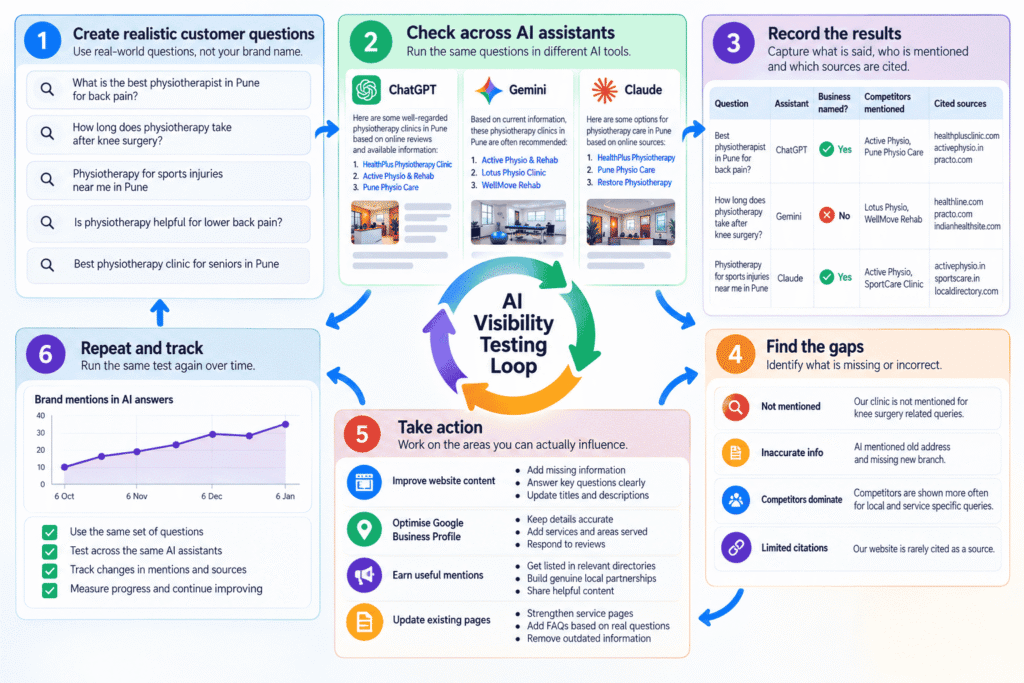
Measure what you can, and stop pretending you can see Google’s internal systems
Your measurement process should use the data available to you and clearly label estimates as estimates.
Google Search Console remains important for understanding how your site performs in Google Search. The brief for this guide also identifies Google’s Generative AI performance reporting and its eligibility conditions as current items that should be checked again at publish time. :chatgpt-content-reference{index=”16″}
You can also use tools that provide backlink information to compare your site with competitors, but remember what those tools can and cannot know.
No third-party SEO platform has access to Google’s private ranking systems or internal AI systems. A score from an external tool is therefore an estimate, not Google’s actual score for your website.
That is another place where the advice filter helps.
If a tool says your AI visibility is 73, that number may be useful for comparing your own results over time if the methodology stays consistent. It does not mean Google has assigned your business a visibility score of 73.
Try the 30-day SEO workflow
A practical 30-day plan starts with fixing the information and pages you already control.
- Week 1: Review technical issues, duplicate URLs, redirects, titles, and indexing data. Use AI to sort the evidence, not invent it.
- Week 2: Rewrite duplicated or weak titles and descriptions. Build your verified brand fact sheet and use it when drafting content.
- Week 3: Review your Business Profile, business information, and review responses. Remove keyword stuffing and unsupported claims.
- Week 4: Run your first AI visibility check. Test realistic customer questions, record the answers and sources, and identify gaps.
Keep the work small enough to finish.
You do not need to redesign the entire SEO strategy because an AI assistant failed to mention your business once. You need a repeatable way to find out what is missing, fix what you can support, and check again.
What to do tomorrow morning
Pick 1 important page on your site and paste its current URL, title, primary search term, audience, actual service or product details, and brand voice into ChatGPT or Claude.
Then ask it to identify what information is missing before it rewrites anything.
That small change will show you the difference between asking AI to do SEO and giving AI enough information to help you do SEO.
Frequently Asked Questions
is ai content bad for seo
AI content is not automatically bad for SEO, but content created mainly to manipulate rankings can violate Google’s spam policies. The safer approach is to use AI where it helps with drafting or analysis while adding accurate information, editorial judgement, and genuine value for the reader.
how to use ai for seo
Use AI for repeatable SEO work such as sorting crawl data, drafting page titles, reviewing content, planning internal links, and analysing visibility logs, while supplying verified business context and checking the output yourself. The most useful starting point is Lesson 4’s before-and-after prompting method.
will ai replace seo
There is no basis in the supplied evidence for predicting that AI will replace SEO. Google says its generative AI search features are based on its core Search ranking and quality systems, so SEO best practices continue to apply. :chatgpt-content-reference{index=”17″}
how ai is changing seo
AI is expanding the SEO job from earning traditional search visibility to also understanding how pages and businesses may appear in AI-generated answers. The practical response is to build useful pages, keep business information accurate, and regularly check how AI search systems describe the business.

Leave a Reply