

Monday, 10:15 am. Your manager forwards a LinkedIn post with one line on top: “Are we doing LLM SEO?” You ask an AI assistant how to do LLM SEO for your company’s site. It sends back 10 neat tips. None mention your site, your pages or your readers. You spend the afternoon on the first tip, which turns out to be something Google says it ignores.
The problem is not that you asked AI for help. The assistant was never given enough information about your site to give a useful answer. Most of the real change is also smaller and more practical than the hype makes it sound.
Current as of September 17, 2026: the Google and OpenAI guidance referenced below reflects the published documentation available today. Recheck the linked pages before acting, especially before the October 6, 2026 publish date.
The LLM SEO question that ate your Monday
The problem with most first attempts at LLM SEO is that a broad question produces advice that could fit almost any website. If the prompt says only “Optimize this page for LLM SEO”, the AI has no clear idea what the page is for, who reads it, what the business knows, or what the reader still needs to know.
You do not need a second SEO job called LLM SEO. You need a few additions to the work you already do, plus a better way to use an AI assistant when reviewing a page.
What is LLM SEO, in one paragraph
LLM SEO is the work of making your content easy for AI assistants built on large language models, or LLMs, to find, understand and cite. An LLM, or large language model, is the kind of AI behind products such as ChatGPT, Gemini and Claude.
Google says its generative AI features, including AI Overviews and AI Mode, are rooted in its core Search ranking and quality systems, so its guidance treats optimization for generative AI search as part of SEO. You will also see AEO, for answer engine optimization, and GEO, for generative engine optimization, used for similar work. For Google Search, the practical point is simple: keep doing good SEO while making content useful for newer search experiences. See Google’s guide to optimizing for generative AI features on Google Search.
What changes in your week: 5 additions
Most of LLM SEO is normal SEO; these are 5 things worth adding to a working SEO’s week.
1. Check that AI search can actually reach your pages
The first LLM SEO check is access: make sure important pages can be crawled, indexed and included in the relevant AI search features.
For Google, a page needs to be indexed and eligible to appear with a snippet, and the site needs to be included in Search generative AI features in Search Console. Google also says crawlable content remains important for its generative AI features.
For ChatGPT search, OpenAI says OAI-SearchBot is used to surface websites in ChatGPT search results. A site that blocks OAI-SearchBot will not be shown in ChatGPT search answers, although it can still appear as a navigational link. OpenAI also says the OAI-SearchBot and GPTBot settings are independent. So this is a check for your site admin or developer, not a reason for you to start changing robots.txt yourself. See OpenAI’s crawler documentation for the current details.
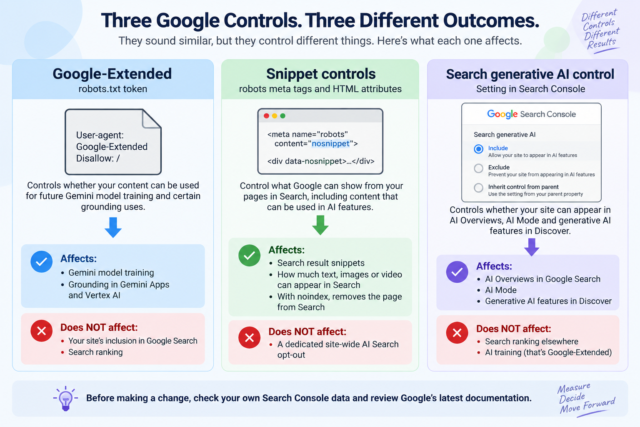
If you are deciding whether to opt out of Google’s AI features, use the separate post on that topic once it is live.
2. Add the Generative AI performance report to your weekly check
The simplest weekly measurement step is to check Search Console’s Generative AI performance report for impressions from AI Overviews and AI Mode.
Google says the report rolled out to all websites worldwide as of August 31, 2026. It lets you view impressions over time and break the data down by page, country, date and device. The number you see is an impression measure, so do not treat it as a promise of clicks or conversions.
Look at the pages receiving the most impressions and note whether the same pages keep appearing. If the report is not visible, Google lists possible reasons, including a site not having enough impressions in generative AI features. See the Generative AI performance report in Search Console for the current details.
3. Brief content around the follow-up questions, inside one page
The useful content change is to make one strong page answer the obvious follow-up questions a reader is likely to have, rather than creating a separate thin page for every variation.
Google describes query fan-out as related searches generated to gather more information for a user’s question. Imagine a person in Chennai searching for “best water purifier for hard water”. Related questions could include “what TDS level is suitable for drinking water”, “how often does an RO membrane need replacement”, and “what should I check before buying an RO purifier for a family of 4”.
You do not need 4 separate pages just because those questions are related. Put useful answers in the page that is already trying to help that buyer, if they genuinely belong there. Google also warns that creating separate pages for every fan-out variation mainly to manipulate rankings or AI answers can violate its scaled content abuse policy.
When you brief an existing page, ask for likely follow-up questions. Then check them against customer conversations, Search Console queries or support messages. For a deeper look at this approach, see How to Rank in AI Overviews.
4. Put first-hand detail in every brief
The most useful addition to many content briefs is one piece of information that only the business can provide.
Google says unique, useful, non-commodity content is likely to matter more for generative AI search presence in the long run than the other suggestions in its guide. It points to first-hand experience and content that adds something beyond common knowledge.
Add a simple field to your brief: “What do we know that a generic article cannot know?” For a home purifier seller, that might be questions customers ask before buying, service issues seen most often, or a real installation process. For a B2B company, it could be an internal process, customer objection or original example.
Most teams skip this because the answer often sits with sales, support or operations, not the SEO team. That extra conversation can give the page something a generic article cannot.
5. Stop spending time on the hacks Google says it ignores
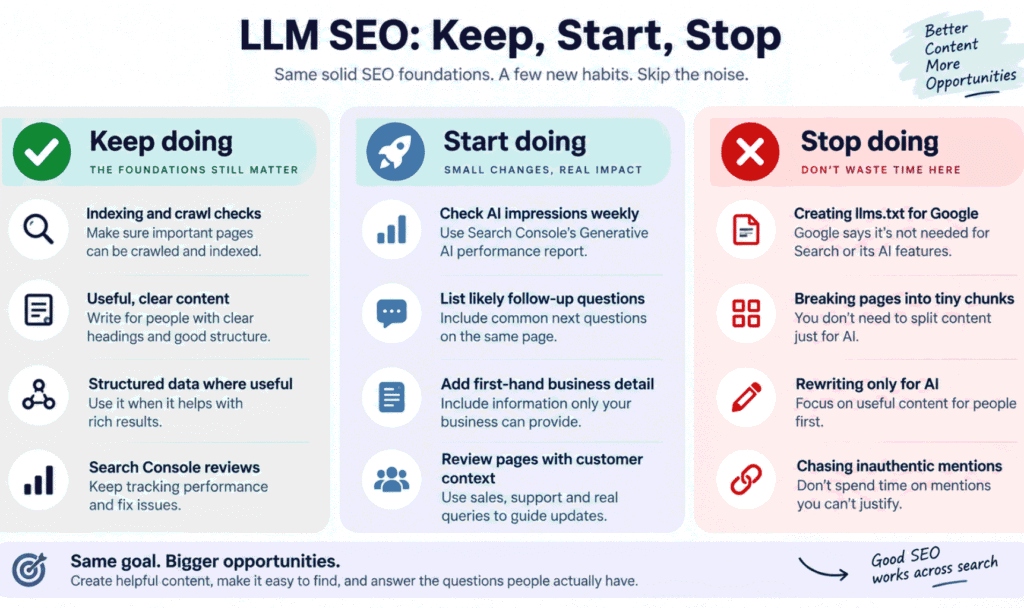
For Google Search, you can stop treating special AI files and other popular hacks as mandatory SEO work.
Google says you do not need llms.txt or other special AI files for Google Search, including its generative AI features. It also says there is no requirement to break content into tiny pieces, rewrite content specifically for AI, or chase inauthentic mentions. Structured data is not required for generative AI search, although Google still recommends using it as part of normal SEO when it helps with rich results.
That is the twist from Monday morning. The first tip was probably one of the things Google already says you can ignore.
One caution: these points are specifically about Google Search. Do not turn Google’s guidance about llms.txt into a claim about what every other AI service does.
| Keep doing | Start doing | Stop doing |
|---|---|---|
| Indexing and crawl checks | Check AI impressions weekly | Creating llms.txt for Google |
| Useful, clear content | List likely follow-up questions | Breaking pages into tiny chunks |
| Structured data where useful | Add first-hand business detail | Rewriting only for AI |
| Search Console reviews | Review pages with customer context | Chasing inauthentic mentions |
Try it: a content gap check you can run on one page today
A useful content gap check asks the AI to inspect one real page for unanswered reader questions, instead of asking it to “optimize” the page with no context.
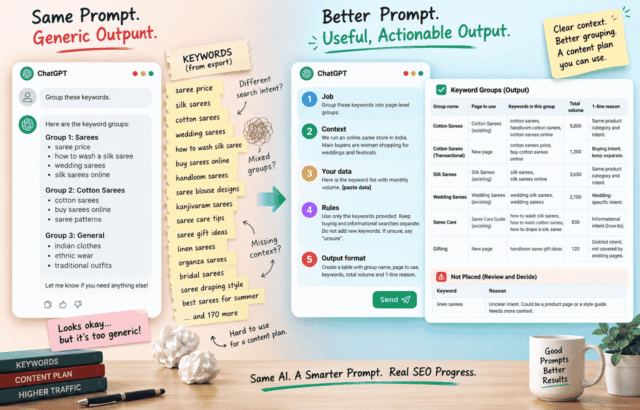
The prompt most people write
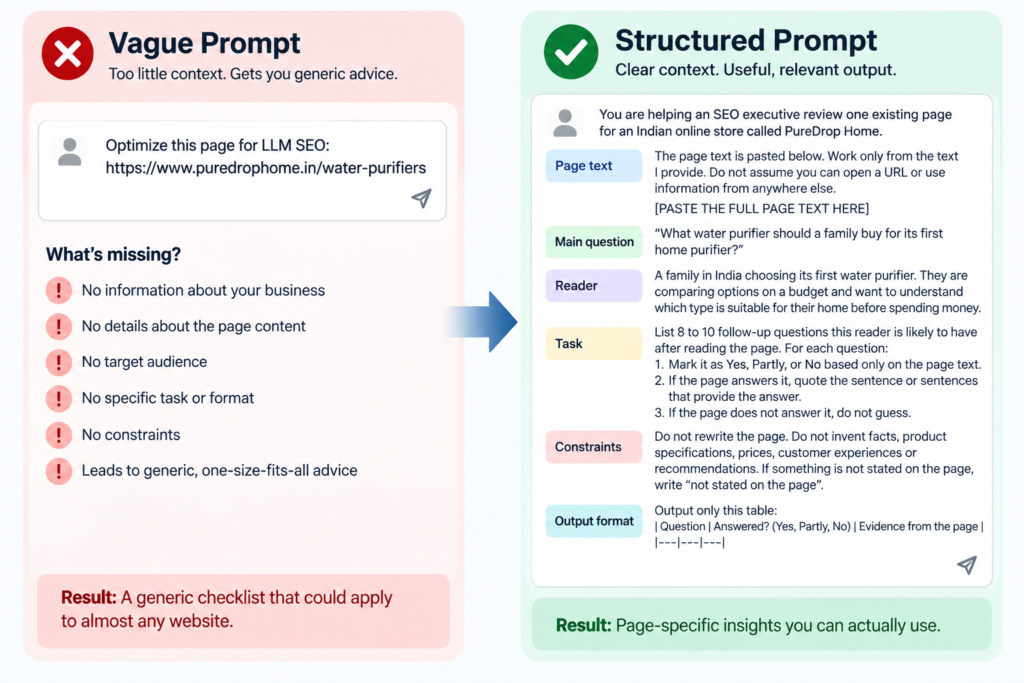
The vague prompt is:
Optimize this page for LLM SEO: [URL]This gives the AI a link and a buzzword, but little else. The request does not explain who the reader is or what the page should help them decide, so the response can fall back on a generic checklist.
The version that actually uses your page
The structured version works from the page text, the reader and the specific review you want done.
Use this example for a fictional Indian online store called PureDrop Home, which sells home water purifiers:
You are helping an SEO executive review one existing page for an Indian online store called PureDrop Home.
The page text is pasted below. Work only from the text I provide. Do not assume you can open a URL or use information from anywhere else.
Main question the page is meant to answer:
"What water purifier should a family buy for its first home purifier?"
Reader:
A family in India choosing its first water purifier. They are comparing options on a budget and want to understand which type is suitable for their home before spending money.
Page text:
[PASTE THE FULL PAGE TEXT HERE]
Task 1:
List 8 to 10 follow-up questions this reader is likely to have after reading the page.
For each question:
1. Mark it as Yes, Partly, or No based only on the page text.
2. If the page answers it, quote the sentence or sentences that provide the answer.
3. If the page does not answer it, do not guess.
Task 2:
Point out sentences that are generic and could appear on almost any competitor's page.
Do not rewrite the page.
Do not invent facts, product specifications, prices, customer experiences or recommendations.
If something is not stated on the page, write "not stated on the page".
Output only this table:
| Question | Answered? (Yes, Partly, No) | Evidence from the page |
|---|---|---|
The question list is the AI’s guess at what readers may ask, so check it against real customer questions, sales calls, support emails and Search Console queries before adding anything to the page.
What to do with the answer
Use the output as a list of ideas to verify, not as a verdict about what your page must contain. The AI is estimating likely follow-up questions from the information you gave it; it cannot tell you what Google or ChatGPT will actually show for a particular search.
Pick 2 or 3 gaps that a real customer would genuinely ask about. Add them to the existing page only when you can answer them accurately. If you want to turn this kind of review into a repeatable writing process, the Claude SEO Writing Playbook can help you build a reusable workflow.
What stays exactly the same
The core SEO work stays the same: make pages crawlable, get important pages indexed, use clear headings, provide a good page experience and publish useful content for people.
Google’s current guidance says its generative AI features are built on core Search systems, which is why these fundamentals still matter. It also says no third-party tool has access to Google’s internal ranking or AI systems, so be careful with anyone promising guaranteed AI search results. A tool can help with your workflow, but its claims should be checked against Google’s published guidance.
Frequently Asked Questions
what is llm in seo
LLM stands for large language model, and in SEO it refers to work aimed at making content useful to AI tools built on those models. The term describes the technology behind systems such as ChatGPT, Gemini and Claude.
What’s the LLM equivalent of SEO?
People use labels such as LLM SEO, GEO and AEO for this type of work, while Google says that, for Google Search, optimizing for generative AI search is still SEO. The labels differ, but the practical work overlaps heavily with normal SEO.
what is llm txt in seo
llms.txt is a proposed text file intended to provide information to AI systems, but Google says Google Search does not use it and that keeping one neither helps nor harms Google visibility. Google also says it is fine to maintain such a file for other services or systems that use it.
Your LLM SEO routine for next Monday
Your next LLM SEO check can take 3 small actions: confirm access, check AI impressions, then review one page for content gaps.
First, ask your developer or site admin to confirm that the relevant AI search crawlers are not blocked. Second, open the Generative AI performance report in Search Console and note your top 5 pages by impressions. Third, run the content gap prompt on the page with the most impressions and check the suggested questions against real customer queries.
Once that works, you can turn the prompt into a reusable workflow with Claude Skills Explained Part 1.

Leave a Reply