
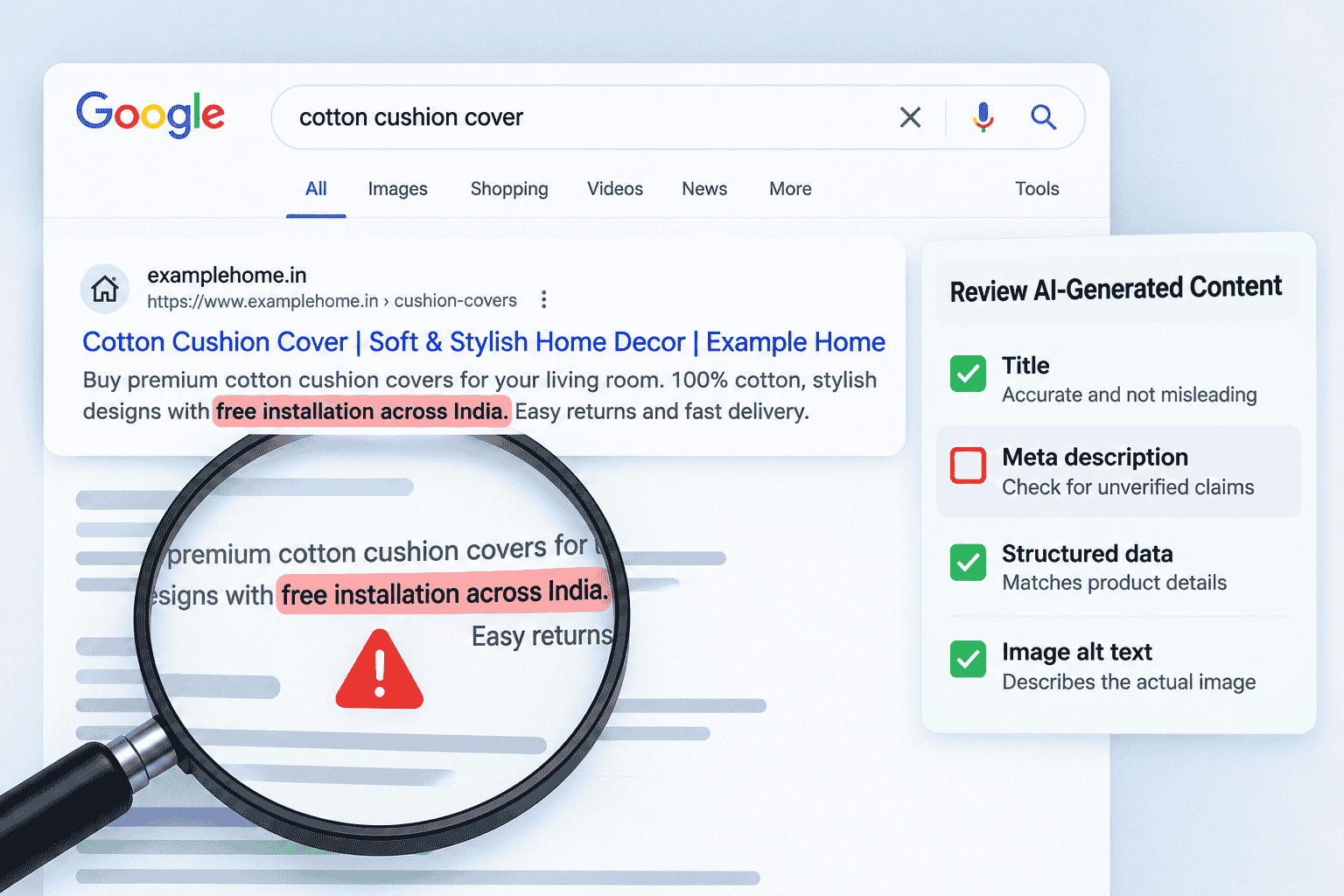

It’s Tuesday afternoon. You have 40 product pages for a home decor store and a Friday deadline. You paste the product names into ChatGPT with one instruction: “Write SEO titles and meta descriptions for these.” Two minutes later, you paste the results into Rank Math and move on.
On Thursday, customer support forwards a complaint. A buyer read “free installation across India” in Google’s search result. The store has never offered installation. Nobody wrote that line deliberately. ChatGPT did, and nobody checked it.
Google’s guidance, updated on 1 October 2026, now explicitly calls for manual fact-checking of AI-generated content, including metadata.
Does Google penalize AI content? The short answer
No, Google does not penalize content simply because AI wrote it. Its guidance focuses on accuracy, quality and relevance, rather than treating AI authorship alone as a reason for a penalty.
The risk comes from using AI to produce large volumes of pages that offer little or no value to people. Google calls this scaled content abuse. It refers to generating many pages primarily to manipulate search rankings rather than help users. This can violate Google’s spam policies, regardless of whether the content comes from AI, humans or a combination of both.
So, is AI content bad for SEO? Not automatically. AI can help you draft useful content, but you remain responsible for what you publish. A product description that accurately explains the item can help shoppers. A meta description promising free delivery or an installation service that does not exist can mislead them.
If you are new to the subject, start with this plain-English guide to AI SEO. The immediate lesson is simpler: using AI is not the main concern. Publishing unchecked claims is.
What Google added on 1 October 2026
On 1 October 2026, Google updated its guidance on generative AI content to explicitly call for manual fact-checking and review before publication.
Google explains that generative AI tools predict likely sequences of words rather than necessarily retrieving and verifying facts. As a result, their output can contain inaccuracies, often called hallucinations. A sentence can sound completely confident while describing a service, feature or offer that does not exist.
Google’s guidance uses the phrase “manually factcheck and review all AI-generated content”. The instruction also applies to metadata, including title elements, meta descriptions, structured data and image alt text. These details can appear in Google Search results, so they need the same attention as the main page copy.
The change was also reported on 1 October by Search Engine Roundtable. Google’s documentation changelog explains that the update aligned its guidance with information from its Search Quality Raters guidelines.
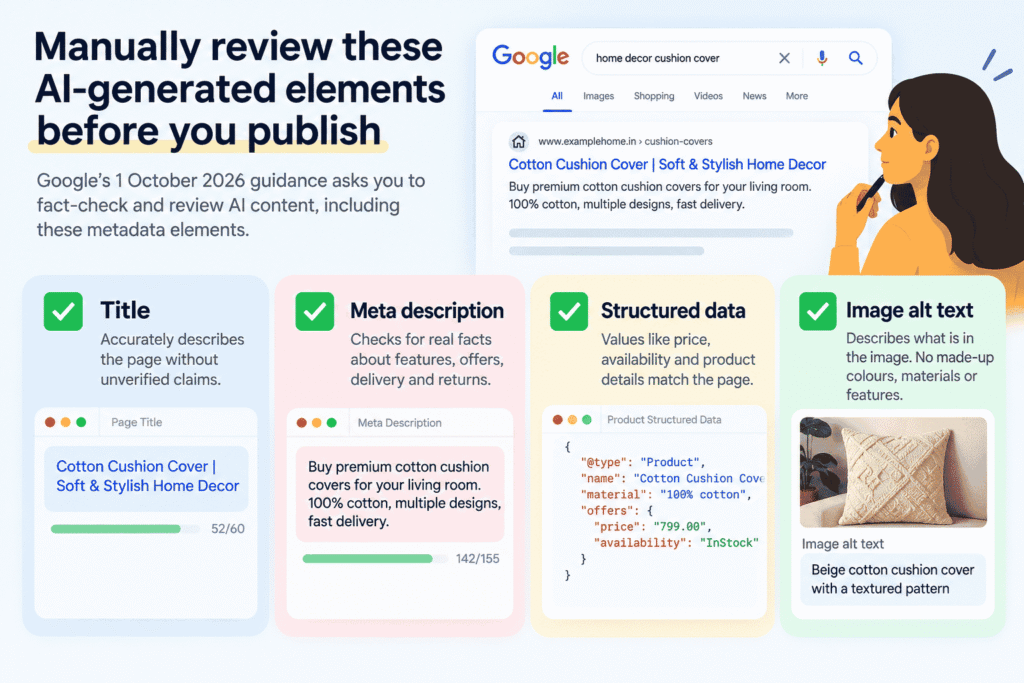
This is the relevant change for SEO teams that generate metadata in bulk. As of October 2026, Google’s published guidance explicitly includes these fields in its manual review instruction. Check the official guidance again on your publication date in case it has changed.
Why meta descriptions are where AI mistakes slip through
Meta descriptions are easy to overlook because they are short, created in bulk and often pasted directly into an SEO plugin without another review.
Think about the usual workflow. You have 40 products to optimise, so you ask AI to write 40 titles and descriptions. The output looks tidy. Each row has a keyword, a title and a description. You scan the spreadsheet, notice no obvious spelling mistakes, and move on to the next task.
But a polished sentence can still contain a false promise. AI might add free shipping, same-day delivery, easy returns, a warranty or a product feature because these details sound typical for an online store. Unless you supplied those facts, it has no reliable basis for claiming them.
Honestly, most teams read their blog introduction twice and their 40 meta descriptions zero times. Metadata needs a review process of its own, especially when the text contains claims about pricing, materials, delivery or customer benefits.
The 10-minute review: give AI the facts, then make it flag its own claims
The fastest way to make AI-written metadata safer is to give it a short fact sheet before it writes, then ask it to show which facts support each claim.
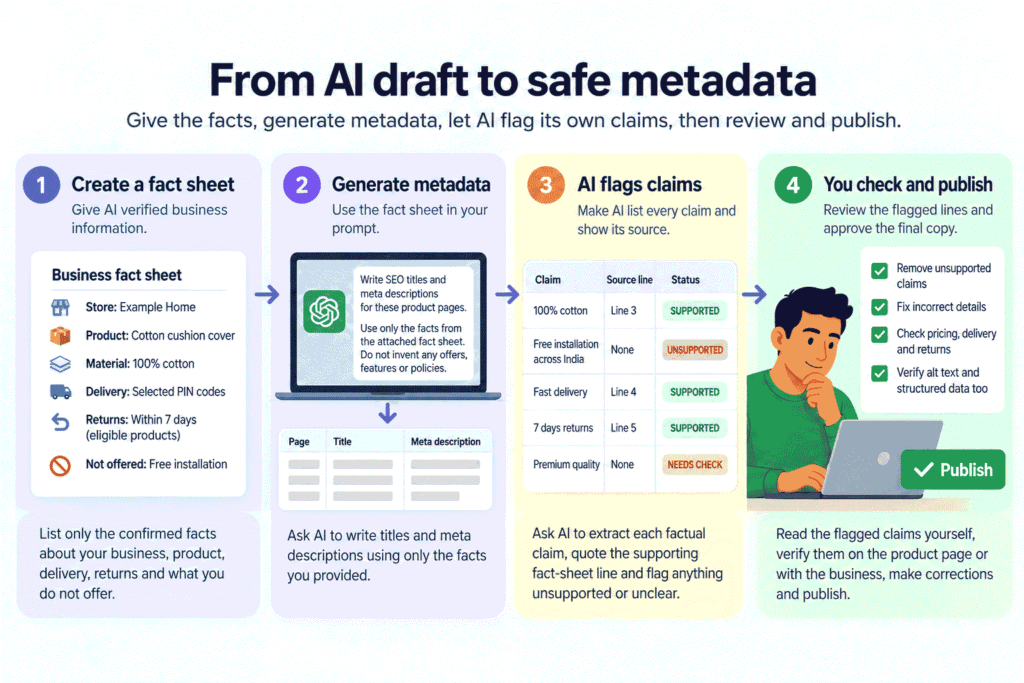
Step 1: Write a 5-line fact sheet
A fact sheet gives AI the verified details it needs and tells it what it must leave out. Write it yourself using information confirmed on the product page or by the business.
For a home decor store, your fact sheet might look like this:
Business: Example Home, an online home decor store in India.
Product: Cotton cushion cover, 40 x 40 cm.
Material: 100% cotton.
Delivery: Delivery is available in selected serviceable PIN codes.
Returns: Returns are accepted within 7 days for eligible products.
Not offered: Free installation is not available.
Price: Use the price shown on the current product page.
This is an invented example for demonstration, not information about a real store. Replace every line with facts you have verified. If the business has not confirmed its return policy or delivery terms, leave those details out until they are checked.
For more help with this first step, read how to use ChatGPT for SEO without getting generic output.
Step 2: Generate metadata with the fact sheet attached
Do not ask AI to guess what your store offers. Give it the fact sheet, the target keyword for each page and clear limits on what it can claim.
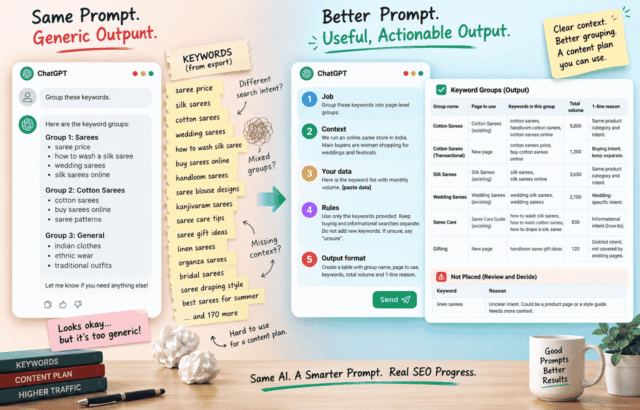
Here is the vague prompt many people start with:
Write SEO titles and meta descriptions for these 40 products: [list]It gives the tool almost no business context. Use this improved version instead, replacing the placeholders and attaching the complete fact sheet and product list.
You are the SEO editor for [store name], an online home decor store in India.
Your task is to write SEO titles and meta descriptions for the product or category pages listed below.
FACT SHEET: THE ONLY ALLOWED SOURCE OF BUSINESS FACTS
[Paste the complete, verified fact sheet here. Give each fact its own numbered line.]
PAGES TO OPTIMISE
[For each page, provide its name, URL if available, and target keyword.]
RULES
1. Use only facts supported by the fact sheet or the page information supplied.
2. Do not invent offers, prices, delivery terms, return policies, product materials, features or services.
3. Use the target keyword naturally when it fits the page.
4. Keep each SEO title under 60 characters and each meta description under 155 characters. These are our working limits, not fixed Google character limits.
5. If a fact is missing, unclear or unsupported, leave it out. Explain the issue in a Notes column.
6. Do not assume that a typical ecommerce benefit applies to this store.
7. Make every title and description specific to the actual page.
OUTPUT
Return a table with these columns:
Page | Title | Meta description | Facts used | Fact-sheet line | Notes
In the Facts used column, list the factual claims included in the title or description.
In the Fact-sheet line column, identify the numbered line supporting each claim.
In the Notes column, flag missing information or anything that needs human verification.
Do not publish or approve any claim on my behalf. Return drafts for review.
The limits of 60 characters for titles and 155 for meta descriptions are common working choices, not Google’s fixed rules. Google can display different snippets depending on the search and device.
Step 3: Ask AI to list every claim and its source line
After the first draft, run a separate check. Paste the generated table and the original fact sheet into the prompt below. This makes unsupported statements easier to spot before you open the SEO plugin.
You are reviewing AI-generated SEO titles and meta descriptions for factual accuracy.
FACT SHEET
[Paste the complete, verified fact sheet again, including its numbered lines.]
GENERATED METADATA
[Paste the complete output table from the previous prompt.]
For every page, inspect the title and meta description separately.
1. List every factual claim, including claims about price, materials, delivery, returns, offers, product features and services.
2. Quote the exact fact-sheet line that supports each claim.
3. If no fact-sheet line supports a claim, label it UNSUPPORTED.
4. If a claim conflicts with the fact sheet, label it CONFLICT.
5. If a claim cannot be checked from the supplied information, label it NEEDS HUMAN CHECK.
6. Do not treat your earlier output as evidence that a claim is true.
7. Do not invent missing facts or create new claims while reviewing.
Return a table with these columns:
Page | Field | Claim | Supporting fact-sheet line | Status | Required action
Use only these status labels:
SUPPORTED
UNSUPPORTED
CONFLICT
NEEDS HUMAN CHECK
Be strict. A plausible claim is not automatically a verified claim.
For example, suppose the invented product is a cotton cushion cover and its fact sheet says nothing about installation.
| Page | Claim | Supporting line | Status | Required action |
|---|---|---|---|---|
| Cotton cushion cover | “Free installation across India” | None | UNSUPPORTED | Remove the claim. The business does not offer installation in this example. |
The review prompt is a checking aid, not proof that the remaining claims are correct. AI can miss a problem or approve an incorrect statement. You still need to read the results.
Step 4: Check the flagged lines yourself
A person must review the flagged claims and spot-check the rest before publication. Compare every important statement with the live product page, confirmed business information or another reliable source.
Remove unsupported claims rather than trying to make them sound more believable. If the price has changed, update it. If a return condition is unclear, ask the person responsible for the policy. If a claim cannot be verified, leave it out.
Once the checks are complete, approve the final copy and publish it through your usual workflow. The AI review saves you from searching blindly for problems, but it does not replace the manual review Google asks for.
The same check for titles, alt text and structured data
Google’s October 2026 guidance names 4 types of metadata that need attention, so apply a version of the same fact-check to each one.
| Element | What to check |
|---|---|
| SEO title | Does it accurately describe the page? Remove claims about offers, features or benefits that the page cannot support. |
| Meta description | Verify every promise about delivery, price, returns, materials and services. |
| Image alt text | Describe what is actually visible in the image. Do not invent a colour, material or product feature. |
| Structured data | Check that values such as price and availability match the information shown on the page, and follow the relevant structured data guidelines. |
This is a factual review, not a full technical SEO audit. You do not need to start by learning code. First, check whether the information represented in each field is true and consistent with the page.
Try it on 5 pages today
Choose 5 of your highest-traffic product or category pages and review their metadata using this process. If your fact sheet is already prepared, allow roughly 10 minutes for the exercise as a working estimate, not a measured result.
Start with the pages that matter most to your business. Create the fact sheet, run both prompts, fix unsupported claims and check the final copy before publishing. When you are ready for more SEO workflows, try these 5 prompts for a junior SEO’s first day.
Frequently Asked Questions
Can Google detect AI content?
Google’s published guidance focuses on content quality, accuracy and relevance, rather than making AI detection the test for whether content should be published. Do not assume that text is safe simply because it reads naturally or appears human-written.
Does AI content rank in Google?
Yes, AI-assisted content can rank when it is useful, relevant and accurate. Using AI alone does not guarantee rankings, and generating large volumes of pages that add little value can create spam-policy risks.
How do I know if Google penalized my site?
Check the Manual actions report in Google Search Console for your verified property. A green check mark indicates that no manual action is reported there, but the report covers manual actions only, so a ranking drop can have other causes.
Google explains how to check the report in its Manual actions report documentation.
Why should you validate AI-generated content?
AI can produce confident statements that are factually wrong because generating likely text is not the same as verifying information. Checking its output helps you catch false business claims, incorrect product details and metadata that misleads searchers before those errors reach your site.

Leave a Reply