

A colleague adds an AI SEO certificate to their LinkedIn profile. You open ChatGPT and type, “which AI SEO course should I do?” Back comes a list of 6 courses, each with a short description. Nothing asks what you already know, what you do at work, or how many hours you actually have. You screenshot it, tell yourself you’ll decide on the weekend, and 3 weeks later, the screenshot is still there.
The answer was weak because the question was too broad. The AI did not know your job, your current level, or your real constraint, which may be time rather than money.
The honest answer first
An AI SEO course can be useful, but it should usually come after you have built a basic working habit with AI and understood what AI search has changed.
A course gives you a syllabus. That can be useful when you need structure, but most people at the start have a different problem. They have too many disconnected things to learn and no order for learning them.
If you already know SEO fundamentals, you do not need to stop everything and become a student again. You need to take one real SEO task, use AI on it properly, understand the changes in search, and then turn what works into a repeatable way of working.
What to learn first, in order
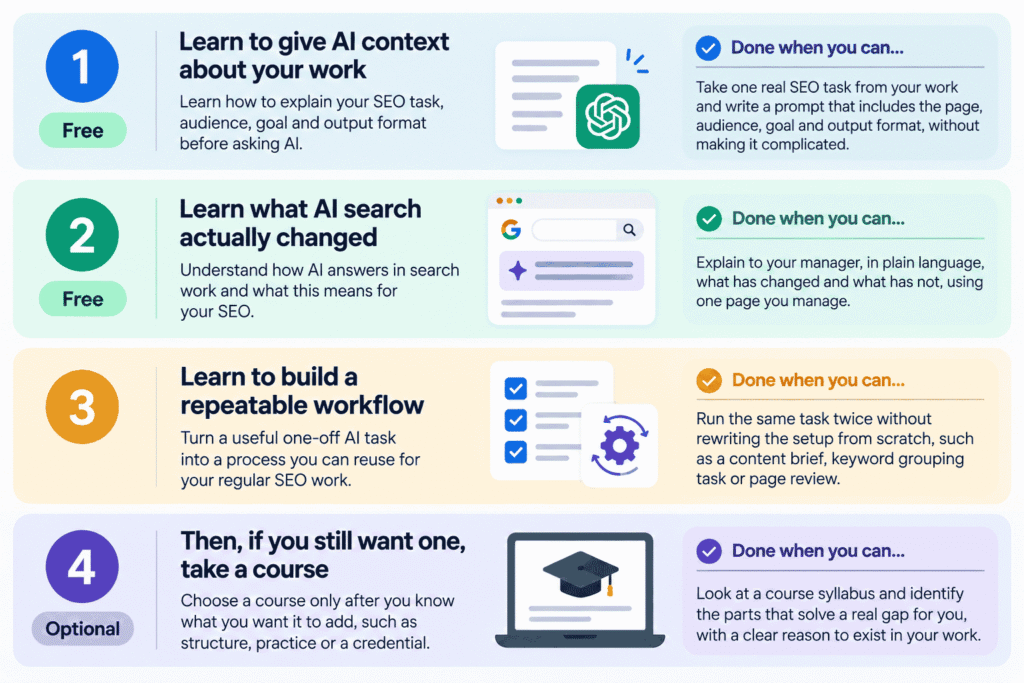
The first thing to learn is how to use AI on your actual SEO work, then understand AI search, then build a repeatable workflow, and only then decide if a course fills a gap.
Step 1. Learn to give AI context about your work
Step 1 is learning how to explain the real SEO task before asking AI to do it.
Done means you can take one task from your current work and write a request that includes the page, the audience, the goal, and the output format. You should be able to do this without turning the task into a long technical exercise.
How to Use ChatGPT for SEO Without Getting Generic Output shows this habit with practical SEO examples.
For example, instead of asking AI to “write keywords for this page”, tell it what the page is about, who the page is for, what the business wants the page to achieve, and what kind of output you need. Then give it the actual page or relevant text when the tool allows you to do so.
Plan for 2 to 3 focused sessions for this step. If you want a free foundation for SEO itself, Google’s SEO Starter Guide for site owners is a useful reference.
Step 2. Learn what AI search actually changed
Step 2 is understanding how AI answers in search affect the way you think about your pages.
Done means you can explain to your manager, in plain language, what has changed and what has not. Your existing SEO knowledge still matters.
As of September 2026, Google’s published guidance says its generative AI features remain rooted in its core Search ranking and quality systems. What has changed is the search experience. AI features can use multiple related searches and retrieved web pages to build an answer, so your work is no longer limited to thinking about a single keyword and a single results page.
Read What Is AI SEO first if this is new to you. Then use LLM SEO, What Actually Changes in Your Day-to-Day Workflow for the practical workflow side.
Plan for 2 to 3 focused sessions here. The finish line is being able to explain the change using one page you manage, not memorising new terms. For the source behind the search changes, read Google’s guide to optimizing for generative AI features on Google Search.
Step 3. Learn to build a repeatable workflow
Step 3 is turning a useful one-off AI task into a process you can reuse.
Done means you can run the same task twice without rewriting the setup from scratch. That could be a content brief, a keyword grouping task, a page review, a title and meta description task, or another SEO activity you already do regularly.
Start with one task you perform every week. Write down the information AI needs every time, the instructions that stay the same, and the parts that change from page to page. Keep those pieces together so the next run starts from the same base.
Give this step 1 to 2 weeks of real work, using the same task more than once. If you use Claude for this kind of repeatable setup, Claude Skills Explained, Part 1 covers reusable AI workflows for SEO and marketing.
Step 4. Then, if you still want one, take a course
Step 4 is choosing a course only after you know what you want it to add.
Done means you can look at a course syllabus and identify the parts that solve a real gap for you. You are looking for structure, practice, accountability, or a credential with a clear reason to exist in your work.
For example, a structured course can cover topics such as generative engine optimization, AI search, content formats, measurement, and practical exercises. One current example is Coursera’s AI SEO: Mastering Generative Engine Optimization course. Another is Semrush Academy’s AI Visibility Essentials with Semrush course. Treat both as examples of structured learning, not as recommendations.
Plan 2 to 4 weeks for a course alongside work. The exact time depends on the course and your available hours. If you want a certificate, check why you need it before paying. Its value depends on the employer, client, or role you are targeting.
When an AI SEO course is actually the right call
A paid course is worth considering when you have a specific reason that free learning and self-directed practice are not solving.
One situation is a deadline from your employer. If your team expects you to learn a defined set of AI SEO skills by a certain date, a structured syllabus can make the work easier to organise.
Another is needing external structure to finish learning projects. A fixed course with lessons and assignments can give that learning a finish line.
A third situation is a role change where a credential is explicitly requested. That is different from buying a certificate simply because it looks useful on LinkedIn.
Build your own plan in 10 minutes
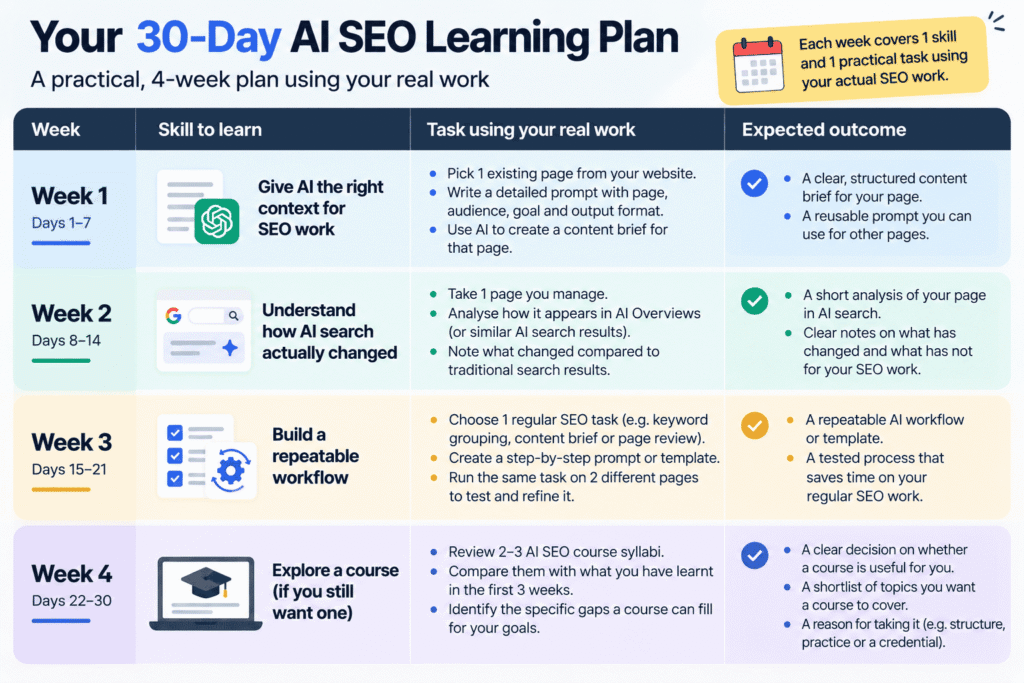
You can build a useful 30-day AI SEO learning plan by giving AI the details of your actual work, time, tool access, and preferred format.
Start with the prompt most people naturally write:
Make me a 30 day plan to learn AI SEO.That prompt is easy to write, but it leaves almost everything important undefined. Try this version instead:
I am an SEO professional with [X years] of SEO experience.
The 3 SEO tasks I spend the most time on each week are:
1. [Task 1]
2. [Task 2]
3. [Task 3]
I have [X] hours available for learning each week. Some days I have 0 hours, so do not assume I can study every day.
The AI tool I already have access to is [ChatGPT / Claude / other tool].
Build the plan around my real work. Every learning task must use a real page or keyword from my work. Do not give me practice exercises based on imaginary websites or keywords.
Create a week-by-week table with a maximum of 4 rows.
Each row must contain:
- 1 skill to learn
- 1 task that uses that skill on my real work
Keep the plan practical for someone who is working full time.
The first prompt has no information about your role, weekly work, available time, or tool. The plan can only be generic. The second prompt forces the plan to use your real SEO work and actual week, so each row has a skill and a task with a clear place in your job.
That is the mechanism: the extra context narrows the answer to the situation you actually need to solve.
What to do next
Pick the 1 of the 4 steps that best describes where you are now, and complete its first real task this week.
You can also use the Claude SEO Writing Playbook as a practical resource while you work through the process. There is no need to decide on a paid AI SEO course before you know what you need it to solve.
Frequently Asked Questions
How to learn seo for free?
You can learn SEO for free by using Google’s SEO Starter Guide as a foundation and practising on real pages and keywords from your own work.
How long does it take to learn seo?
There is no single learning time because the answer depends on what you already know and how much practical work you can do each week.
Will ai replace seo?
AI does not make the existing SEO foundation irrelevant, and Google says its generative AI search features continue to rely on core Search ranking and quality systems.
The practical change is that SEO work now also needs to account for AI-driven search experiences and how information is retrieved and presented in those experiences.
What is seo for ai called?
SEO work focused on AI search is described by different terms, including AI SEO, answer engine optimization, and generative engine optimization.
Google’s current guidance says AEO and GEO are terms used for work focused on improving visibility in AI search experiences, while Google itself describes this work as optimizing for the search experience and therefore still SEO.
Leave a Reply